Anata Intelligence
 Shipping OS
Amazon Advertising
Why Amazon Ads Should Be Judged on a Trailing 7-Day Blended ACoS, Not a Daily Number
By Anata Inc. ·

The short answer.
Judge Amazon ads on trailing 7-day blended ACoS, not a daily swing. Daily data can raise an early warning; mature 7-day cohorts guide near-term decisions, and mature 14-day cohorts support stronger conclusions. Pace budgets inside your guardrails, and keep higher-risk changes behind human approval. Compare like-for-like product groups, use the same attribution basis throughout the review, and investigate the sales and spend behind any movement before changing bids, budgets, or campaign structure.
Section 01
What is blended ACoS, and how is it different from a single campaign's ACoS?
ACoS is advertising cost of sales: ad spend divided by the revenue those ads were given credit for. Anata's ACoS glossary is clear that this number measures how efficient a single campaign is and that it is a poor way to judge a whole account, because it says nothing about organic sales the same advertising may have helped create, and because a low ACoS can be produced simply by cutting spend until only the safest searches remain.
Blended ACoS, as we use it when judging an account or a set of products, is that same formula applied to the group you are actually deciding about: total ad spend over the window, divided by the ad-attributed revenue of those campaigns or products together. It is not a different metric from ACoS, and it is not TACoS. TACoS divides ad spend by total revenue, ads plus organic, and answers whether advertising is growing the whole business. Use TACoS for that question. Use blended ACoS when the question is: for the ads we ran, what did the attributed sales cost us across the whole set, not just the campaign that spiked this morning?
Do not set one ACoS target for every product. A launch product and a mature bestseller are doing different jobs. Anata Intelligence's Advertising Engine assigns each reviewed product a role: Scale, Defend, Test, Rehabilitate, or Contain. The efficiency expectation follows the job of the product. Compare the result to break-even ACoS, the point where an extra advertised sale stops adding profit, before you treat a percentage as a ceiling.
Section 02
Why is a daily ACoS a bad number to operate from?
A single day's ACoS moves for reasons that often have nothing to do with a bid you should change this afternoon. Attribution may still be open. Delivery is uneven across hours. One large order, one out-of-stock stretch, or one delayed conversion can swing the percentage. If you raise or cut bids off that number, you are reacting to noise, and you will often reverse the same change a day later.
The Advertising Engine states the measurement standard in plain terms: daily data can raise an early warning; mature 7-day cohorts guide near-term operating decisions; mature 14-day cohorts support stronger conclusions. A confirmation that Amazon accepted a bid change is not proof that the change caused a business result. Keep those records separate, the same way our guide to governing automation changes separates recommendation, approval, execution, confirmation, and measured outcome.
One current Anata operating data point shows the scale this policy can govern: MyBevi had 99 Sponsored Products campaigns launched since May 6, 2026, including 73 in October. That is an operating count from Anata Intelligence, not evidence that a 7-day review window caused a sales result.
Section 03
What does a trailing 7-day window actually mean?
Trailing 7-day means the last seven complete days of mature reporting, not a calendar week you reset every Monday, and not a day that is still collecting attributed sales. Look at blended ACoS for that rolling window, against the product's role and against break-even ACoS.
Use the 7-day figure to decide whether the account, or that product set, is inside the guardrail you already set. Use the 14-day mature cohort when you need a stronger conclusion, such as whether a role, a budget, or a structural change should stick. Use a daily figure only as a warning light: something may need a look, not an immediate bid rewrite.
This is a different window from TACoS trend analysis. Anata's TACoS guide recommends a 30-day rolling window for TACoS trends and a clean calendar month for reporting, and it notes that weekly TACoS figures are noisy around deals and seasonal spikes. That advice still holds for TACoS. Operating ACoS and business-level TACoS answer different questions, so they are allowed to use different windows.
Section 04
How should budget pacing work with that window?
A budget is not a bid. Amazon treats them separately: a bid is the maximum available for an eligible click; a campaign budget is how much the campaign is willing to spend over the applicable day. Pacing is about whether spend is being used in line with the plan across the week you are judging, not whether one day came in hot. Our guides on Amazon Ads budget rules and allocating retail media budget across products cover the campaign-level mechanics; this is the account-level judgment that sits on top.
First, record the current daily budgets, campaign types, products, and the reporting window you will use: the trailing 7-day blended ACoS, not yesterday. Confirm the product is in stock, the offer is eligible, the detail page is ready, and the product has a role. A budget increase cannot repair an ineligible offer or a thin listing.
Set budget and acquisition-cost guardrails before any automation is allowed to spend. In Anata Intelligence, routine work stays inside those guardrails. Turning Automation ON does not mean spend whatever is left in the budget.
If you use Amazon's own budget rules, match the rule to the decision: a schedule-based rule for a known event window, or a performance-based rule only when the threshold matches your decision model. Record the original budget, the trigger, and the rollback condition. Do not change budgets and bids in the same run if you want to explain the result later.
After a change, review delivery, spend, and attributed outcomes on the same mature window you used to decide: 7 days for a near-term operating call, 14 days for a stronger one. Do not declare the change a success from the next morning's ACoS. Amazon can flag that a campaign with a budget below a suggested level may run out of budget early. Treat that as a delivery signal, not as proof that the budget should automatically increase. Your operating policy is still the 7-day blended window and the limits you set.
Section 05
What does automation change, and what does a person still decide?
This is the question teams ask when ads look unprofitable for a day and they want to know whether software already acted, or whether a person should.
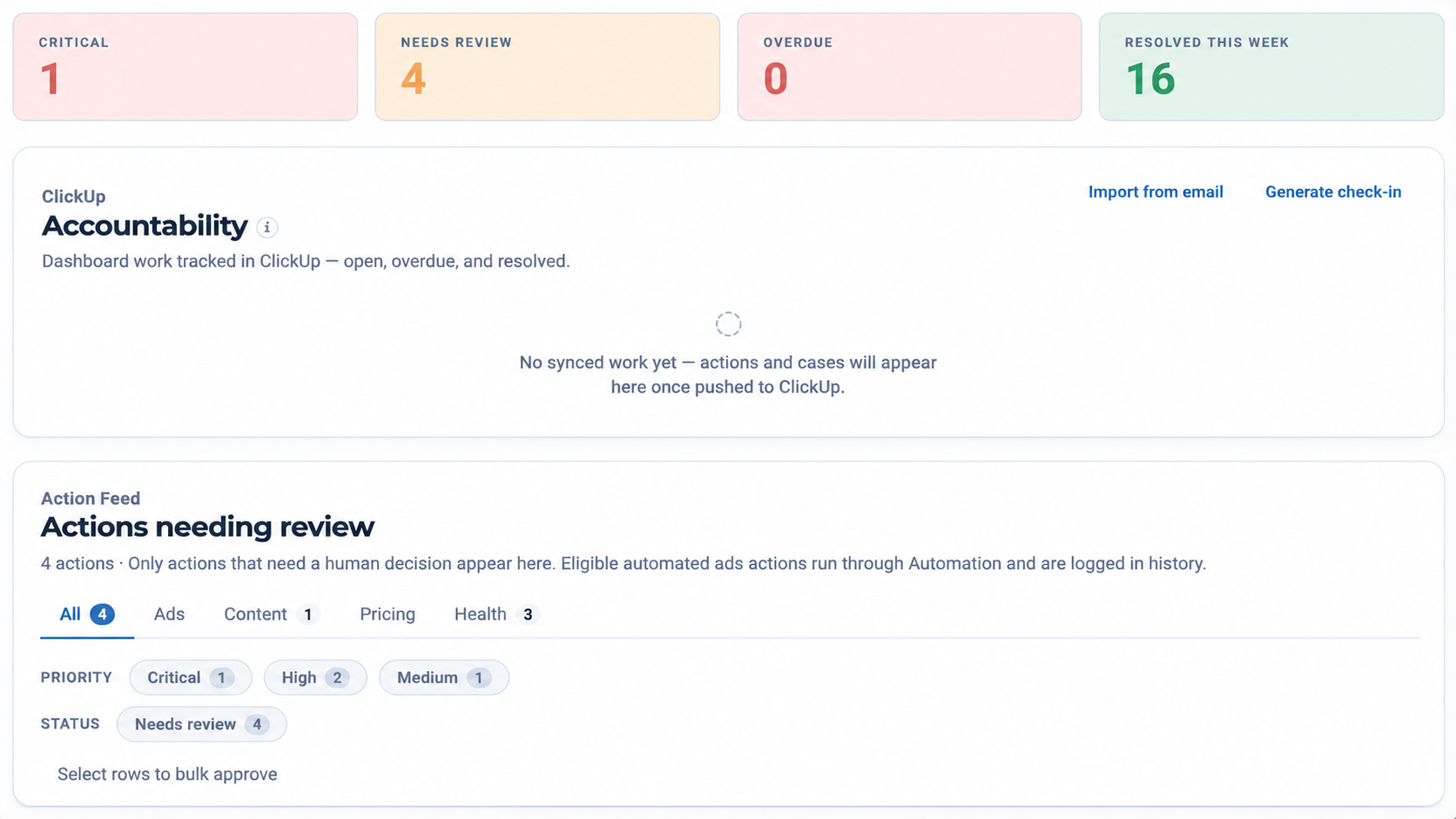
In the Advertising Engine, every eligible action still has to pass the same checks: scope, authority, evidence, ceilings, protections, limits, and cooldowns. The loop is client goal, product role, qualified opportunity, safety check, action or hold, and Amazon confirmation. Read the provider state back, and do not treat a queued or sent change as complete.
A person still owns the product roles, acquisition-cost and budget guardrails, Automation ON or OFF, higher-risk approvals, holds on a product, action, or campaign, and the decision to use managed Amazon PPC instead of, or alongside, the software. Automation OFF means no unattended Amazon write. Automation ON still only permits eligible work. The Advertising Engine does not replace a PPC manager.
The current decision contract is centered on Sponsored Products. Amazon Ads remains the system of record. Anata uses authorized Amazon Ads data and adds product roles, available profit, inventory, Buy Box, and listing context, plus the approval trail. AI-assisted analysis does not, by itself, authorize an Amazon Ads change. Amazon's Ads API and Campaign Manager rules can move budgets or bids programmatically; those are capabilities, not an operating policy.
If Anata operators run the account for you, they work inside the access you grant, on the same platform, with the same approval and measurement rules. Your ad spend is still billed by Amazon on your advertising account. Anata's software plans start at $99 per month for Brand and $999 per month for Agency after a 14-day trial. That is a separate charge from Amazon's media cost. Higher-risk changes wait for your approval, and routine work stays inside the budget and acquisition-cost guardrails you set.
Section 06
How should a team use this in a weekly review?
Open the trailing 7-day blended ACoS for the account and for each product role, next to break-even ACoS and TACoS on its longer window. List only the products whose 7-day figure is outside the guardrail for their role. Ignore a single red day that the 7-day number does not confirm.
For each exception, check inventory, Buy Box, listing, and offer eligibility before touching bids or budgets. Review the action record: which changes were recommendations, which were approved, which Amazon confirmed, and which are still in a cooldown or hold.
Make at most a bounded change, annotate it, and set the review for a mature 7-day window. Use 14 days when the decision is larger. You do not optimize every product toward one account-wide number, and you do not confuse a reporting movement with a proven result.
Questions, answered.
- Should I ever act on a daily ACoS?
- Use it as an early warning, not as the decision. If a daily figure moves sharply, check inventory, offer eligibility, delivery, and whether a change was already sent to Amazon. Wait for the trailing 7-day blended number before you change bids or budgets, unless you have a clear operational break such as a product that went out of stock.
- What is the difference between blended ACoS and TACoS?
- Blended ACoS is ad spend divided by ad-attributed revenue for the set of campaigns or products you are judging. TACoS is ad spend divided by total revenue, including organic. ACoS tells you what attributed sales cost; TACoS tells you whether advertising is growing the whole business.
- Does a 7-day blended ACoS above target mean automation failed?
- No. A higher ACoS can be intended for a Scale or Test role. It can also reflect inventory, a listing problem, or a reporting window that is not yet mature. Read the product role, the guardrails, and the action record before assuming a bid engine is at fault.
- Will Anata Intelligence change my campaigns without asking?
- Higher-risk changes wait for your approval. Routine work stays inside the budget and acquisition-cost guardrails you set. Automation OFF prevents unattended writes. Automation ON still has to pass scope, holds, and safety checks.
- Who controls the ad spend itself?
- You do. Spend is billed by Amazon on your advertising account. Anata works with the access you grant. Software fees and any managed-service fees are separate from media cost.
- How is this different from Amazon's own budget and bid rules?
- Amazon's Campaign Manager rules can adjust budgets or bids when configured conditions are met, and the Ads API can manage campaigns programmatically. Those are capabilities, not an operating policy. You still need a measurement window, product-level goals, limits, and a record that separates a recommendation from a confirmed change.