
 Anata Intelligence
 Shipping OS
Shipping Operations
USPS Ground Advantage vs Ground Advantage Cubic: Which One Is Actually Cheaper?
By Anata Inc. ·
Reviewed by Anata Inc. ·
Crossover weights were derived by comparing the September 14, 2026 USPS commercial weight and Cubic price files zone by zone. Peak adds are the August 25, 2026 USPS newsroom amounts. Illustrative export and rate-shop figures use fictional postage.

The short answer.
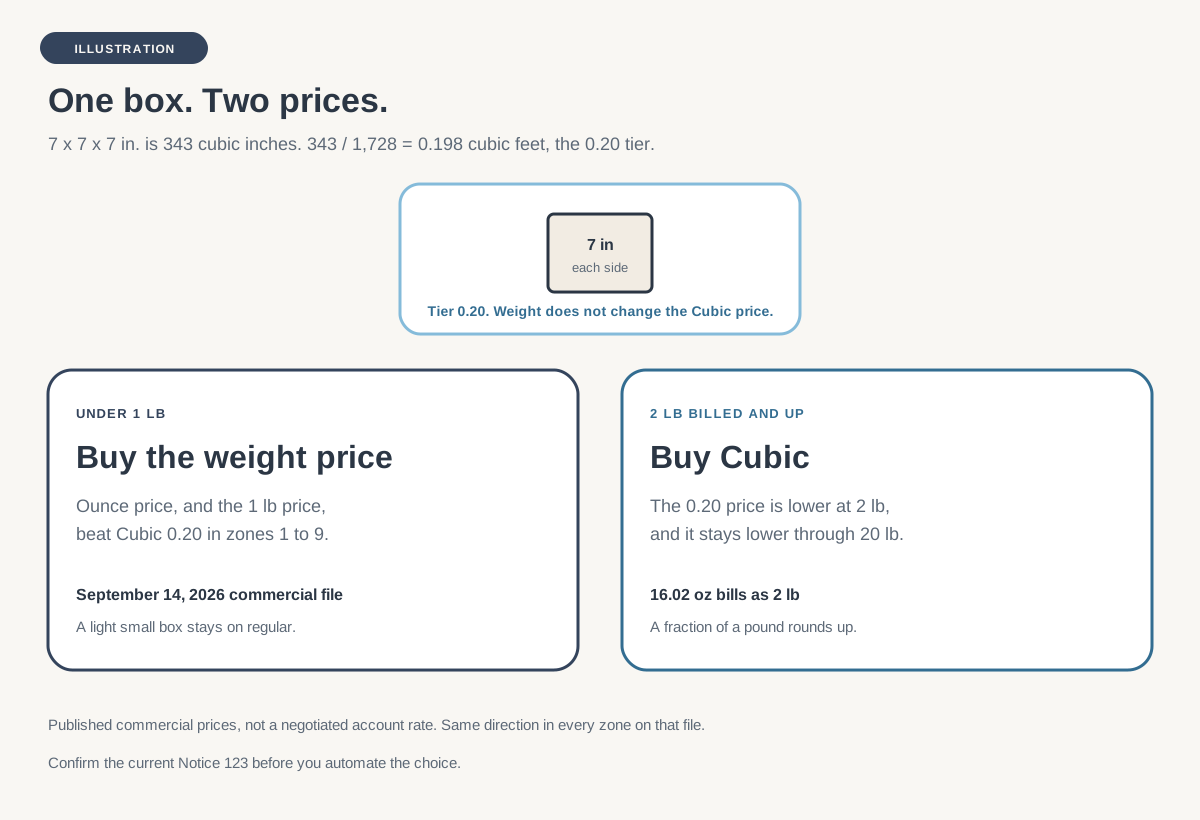
Ground Advantage and Ground Advantage Cubic are the same USPS service. You are choosing a price, not a second carrier. Regular postage uses billed weight and zone. Cubic postage uses a volume tier and zone, and weight does not change that price when the parcel is at or under 1 cubic foot, at or under 20 pounds, no longer than 22 inches, and not a roll or tube. For a 7 by 7 by 7 inch box, 343 cubic inches divided by 1,728 is 0.198 cubic feet, the 0.20 tier. In the USPS commercial files marked September 14, 2026, that tier costs less than the weight price starting at 2 pounds billed, in every zone. Under 1 pound, the regular price costs less. Any fraction of a pound rounds up, so 16.02 ounces bills as 2 pounds. Compare both prices on the measured parcel. Cubic is not dimensional weight.
Section 01
Same service, two price lists
You are not choosing a carrier. USPS Ground Advantage Commercial has one handling description and two ways to price an eligible parcel. Domestic Mail Manual section 283 prices an ordinary piece by weight and zone. It prices a Cubic piece by zone and cubic tier. The Ground Advantage product page describes a domestic package service with a 2 to 5 business day service standard, and USPS Tracking included in the price. The same part of the manual says USPS does not guarantee delivery of Ground Advantage Commercial within a specified time. Buying the Cubic price does not buy a faster network. Buying the weight price does not buy a slower one. The label is the same service either way.
Cubic is a commercial price, not a retail counter price. Section 283 makes Cubic available to eligible Ground Advantage Commercial customers, including eligible return-service customers, when postage is paid by an approved commercial method such as qualifying PC Postage, an approved meter that transmits transaction data, permit imprint, or an eligible returns service. The July 12, 2026 text sets the box limits in one place. The piece must measure 1 cubic foot or less, weigh 20 pounds or less, and the longest side must not exceed 22 inches. Rolls and tubes cannot take the Cubic price. A rectangular or nonrectangular parcel is measured at each side's maximum point, each side is rounded down to the nearest quarter inch, and length times width times height is divided by 1,728. That result picks one of ten tiers, from 0.10 up to 1.00 cubic foot. A soft pack or padded envelope uses a different test, length plus width, and that total cannot exceed 36 inches. If the parcel misses a limit, there is no Cubic price to compare.
The manual's own measurement example is worth keeping next to the scale. A piece of 6-1/8 by 5-7/8 by 6-3/8 inches rounds down to 6 by 5-3/4 by 6-1/4. The manual multiplies those sides to 215.6, divides by 1,728, and gets 0.125. That exceeds the 0.10 tier, so the piece is tier 0.20, the band from just over 0.10 up to 0.20. Write the raw sides down before you round them. A later audit cannot reconstruct a tier from a catalog size or from the rounded numbers alone.
The working habit is small. Measure the sealed parcel once. Keep the raw measurements, the rounded measurements, the scale weight, and the zone with the label. Then read both prices the parcel is actually eligible for. A warehouse that defaults every small box to Cubic, or every small box to the weight price, overpays on the half of the catalog that sits on the other side of the line. The line moves when USPS republishes prices. It does not move because an export makes one of the two rows look unfamiliar. The neighbor decision, Ground Advantage or Priority Mail, is a real service choice. This one is not.
Section 02
The 7 by 7 by 7 example
A 7 by 7 by 7 inch box is the argument operators actually have. Seven inches is already on a quarter-inch mark, so the Cubic round-down changes nothing. The volume is 7 times 7 times 7, which is 343 cubic inches. Divide by 1,728 and you get 0.198 cubic feet. Section 283 puts a piece that measures more than 0.10 and up to 0.20 cubic foot in the 0.20 tier. The Cubic price is the 0.20 price for that zone. Two pounds or twelve pounds, the Cubic number does not change, as long as the parcel stays at or under 20 pounds and inside the other limits.
The weight price does change, and USPS rounds up. Below one pound, postage steps through 4 ounces, 8 ounces, 12 ounces, and 15.999 ounces. Any fraction of an ounce moves to the next of those steps. In the September 14, 2026 commercial weight file, those four steps happen to share one price inside each zone, so a 4 ounce parcel and a 15 ounce parcel take the same published commercial price per zone on that file. At and above one pound, any fraction of a pound is the next whole pound. The manual's example is 1.25 pounds billed as 2 pounds. A parcel at 16.00 ounces is exactly 1 pound and takes the 1 pound price. A parcel at 16.02 ounces is a fraction over 1 pound, so the price increment is 2 pounds. On this box, that 0.02 ounce miss is the difference between a weight price that still beats Cubic and a weight price that does not.
The dollars below are the USPS commercial price files marked Final, September 14, 2026: one file for weight, one for Cubic. The same Ground Advantage commercial prices appear in the Notice 123 PDF marked effective October 4, 2026. These are published commercial prices. They are not a negotiated account price, not a Shipping OS quote, and not a customer invoice. For the 0.20 tier, the weight price is lower at every ounce step and at 1 pound, in zones 1 through 9. The Cubic price is lower at 2 pounds, and it stays lower through the 20 pound Cubic limit, in every zone. At 2 pounds the gap is $0.17 in zone 1 ($8.22 Cubic against $8.39) and $1.03 in zone 8 ($12.39 Cubic against $13.42). Zone 9 matches zone 8 on this file. Zone 5 sits between them: $9.92 Cubic against $10.50 at 2 pounds. A negotiated discount or a fee can close a 17 cent gap. It does not change the method. Compare the two prices you will actually be charged.
Read the pattern, not a single box. Comparing those two files zone by zone, the billed weight where Cubic first costs less than the weight price is the same in all nine zones, and Cubic stays lower through 20 pounds once it crosses. Under 1 pound, the regular price is lower for every tier, in every zone. The pattern follows the tier for 0.10 through 0.90: the 0.10 tier crosses at 1 pound, the 0.20 tier at 2 pounds, and so on through the 0.90 tier at 9 pounds. The 1.00 tier does not cross at 10 pounds. At 10 pounds the weight price is still lower. In zone 1 the published 10 pound price is $12.56 and the 1.00 Cubic price is $13.07. Cubic first wins at 11 pounds, where zone 1 is $13.80 on the weight price. Confirm the current Notice 123 before you turn any row into an automatic rule. Account prices can differ from the published commercial file.
| Billed weight | Zone 1 weight | Zone 1 Cubic | Zone 5 weight | Zone 5 Cubic | Zone 8 weight | Zone 8 Cubic | Lower price |
|---|---|---|---|---|---|---|---|
| 15.999 oz or less | $7.33 | $8.22 | $8.24 | $9.92 | $8.95 | $12.39 | Weight |
| 1 lb | $8.01 | $8.22 | $9.29 | $9.92 | $11.22 | $12.39 | Weight |
| 2 lb | $8.39 | $8.22 | $10.50 | $9.92 | $13.42 | $12.39 | Cubic |
| 3 lb | $9.04 | $8.22 | $12.12 | $9.92 | $16.30 | $12.39 | Cubic |
Dollar amounts are the published commercial prices in the September 14, 2026 USPS files. Zone 9 matches zone 8 in those files. During the peak window, add the temporary amount in the later table. That add does not change the winner in these rows.
| Cubic tier | What the tier covers | Billed weight where Cubic first costs less |
|---|---|---|
| 0.10 | Up to 0.10 cubic foot | 1 lb |
| 0.20 | More than 0.10 up to 0.20 | 2 lb |
| 0.30 | More than 0.20 up to 0.30 | 3 lb |
| 0.40 | More than 0.30 up to 0.40 | 4 lb |
| 0.50 | More than 0.40 up to 0.50 | 5 lb |
| 0.60 | More than 0.50 up to 0.60 | 6 lb |
| 0.70 | More than 0.60 up to 0.70 | 7 lb |
| 0.80 | More than 0.70 up to 0.80 | 8 lb |
| 0.90 | More than 0.80 up to 0.90 | 9 lb |
| 1.00 | More than 0.90 up to 1.00 | 11 lb, not 10 lb |
Compared zone by zone, zones 1 through 9. The first whole-pound price at which Cubic was strictly lower was the same in every zone, and Cubic remained lower at every heavier pound through 20. Under 1 pound the weight price was lower for every tier. Confirm on the current Notice 123. This is not your account's rate card.
Section 03
Cubic is not dimensional weight
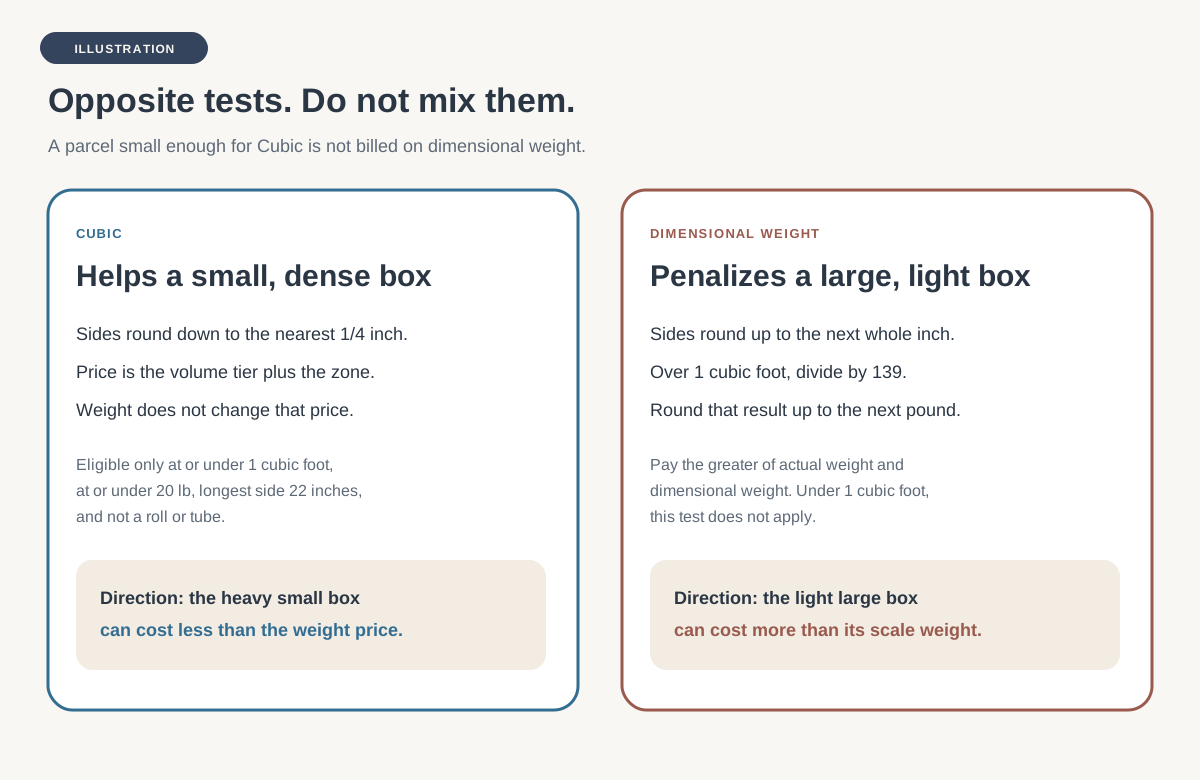
Cubic and dimensional weight both start from the size of the box, and they push the price in opposite directions. Cubic is a price for a small parcel with enough weight. Dimensional weight is a higher billable weight for a large, light parcel. Mixing the names is how a 7 inch box gets repacked for the wrong reason, or a carton of pillows gets priced as if a volume tier will save it. If the parcel is over 1 cubic foot, you are not in the Cubic comparison at all.
The manual separates the tests. For Cubic, round each side down to the nearest quarter inch, divide the cubic inches by 1,728, and stop. The tier and the zone are the price. For dimensional weight on Ground Advantage Commercial, the parcel must exceed 1 cubic foot, which is 1,728 cubic inches. The July 12, 2026 text says to round each side up to the next whole inch, multiply, and if the result still exceeds 1,728, divide by 139 and round up to the next whole pound. You pay the greater of that number and the actual weight. If dimensional weight would exceed 70 pounds, you pay the 70 pound price. The product page states the same divisor, 139, and the same rule that a fraction of an inch rounds up. A parcel small enough for Cubic is at or under 1 cubic foot, so the regular Ground Advantage price beside it is actual billed weight, not a dimensional weight. There is no third number hiding in the volume of a 7 by 7 by 7.
The rounding direction is the part people skip. Cubic rounds sides down, which can only make the tier smaller or leave it alone. Dimensional weight rounds sides up, which can only make the calculated weight larger or leave it alone. A side of 12.2 inches is 13 inches in the dimensional-weight test. It is not a Cubic measurement unless you are pricing a parcel that is otherwise inside the Cubic limits, and then you round down to the quarter inch, not up to 13. Use the measurement that matches the price you are checking. The longer guide on dimensional weight walks the formula for UPS, FedEx, and USPS, including parcels that have already crossed 1 cubic foot. This page only needs the boundary. At or under 1 cubic foot, USPS Ground Advantage is not billing the regular price on dimensional weight.
Section 04
What zone means, and what the letter is not
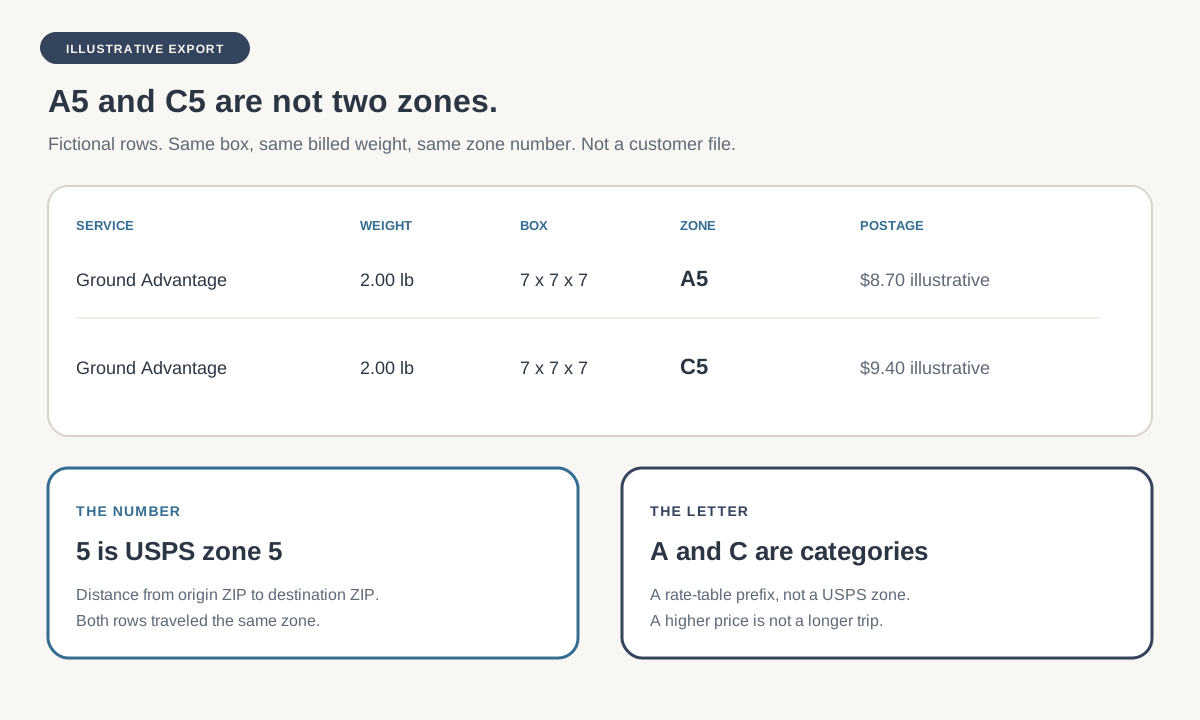
USPS zones are numbers. PostalPro's zone-chart page says postage for zoned mail is based on the weight of the piece and the distance it travels, and that zones are designated local or 1 through 9. The zone comes from the ZIP Code where the piece enters the mailstream and the ZIP Code that delivers it. You look the pair up on the Domestic Zone Chart. You do not invent it from a mileage guess. In the September 14, 2026 commercial files, the published Ground Advantage price rises as the zone number goes from 1 to 8, on both the weight rows and the Cubic rows, and zone 9 matches zone 8. Farther, on that file, costs more for both prices. The zone does not decide which of the two prices wins. The same crossover weight showed up in every zone.
A Shipping OS label export can show a letter in front of that number. A5 and C5 are the example to learn, and the rows in the drawing are fictional. The 5 is the USPS zone. The letter is a rate category in the software's rate table, tied to the destination ZIP, not a USPS zone and not a distance. USPS will not describe a parcel as traveling to zone C. If two labels share the box, the billed weight, and the zone number, and the prices differ, the letter is a reason to look at the rate category. It is not evidence that one package traveled farther. A C or a D that costs more than an A does not mean the trip was longer. This page does not assign a discount percentage to any letter. The export does not publish one here, and a public guide should not invent one.
Keep the zone number when you audit. If the number is wrong, both prices are wrong, in the same direction, because both price lists use the zone. If the letter is unexpected, the zone can still be right and the rate category can still be what changed the dollars. Fix the column you actually misread. The drawing uses made-up postage on purpose, so nobody can mistake it for a USPS price or for a shipment that left a real dock.
Section 05
Peak season does not change which product wins
USPS announced a temporary price change on August 25, 2026. The newsroom notice says it covers retail and commercial domestic competitive parcels, including USPS Ground Advantage, from 12 a.m. Central on October 4, 2026 until 12 a.m. Central on January 17, 2027. USPS Employee News later reported that the Postal Service implemented the temporary changes on October 4, and that they remain until midnight Central on January 17, 2027. For commercial Ground Advantage, the August 25 notice states dollar adds, not a percentage. Zones 1 to 4: $0.40 on 0 to 3 pounds and Cubic tiers 1 to 3, $0.65 on 4 to 10 pounds and Cubic tiers 4 to 9, $1.05 on 11 to 25 pounds and Cubic tier 10, and $3.15 on 26 to 70 pounds and oversized. Zones 5 to 9: $0.55, $1.05, $1.75, and $7.70 on those same bands. In the Domestic Mail Manual, tiers 1 to 3 are 0.10, 0.20, and 0.30. Tiers 4 to 9 are 0.40 through 0.90. Tier 10 is the 1.00 tier. Cubic cannot use the 26 to 70 pound band, because Cubic stops at 20 pounds.
The add sits on both prices, and the bands line up at the crossover. A 0.20 tier parcel billed at 2 pounds is in the 0 to 3 pound band, and that tier is inside Cubic tiers 1 to 3, so the weight price and the Cubic price take the same dollar add: $0.40 in zones 1 to 4, $0.55 in zones 5 to 9. The gap does not change. The same match holds for the other rows in the crossover table. Tiers 0.10 to 0.30 cross inside 0 to 3 pounds. Tiers 0.40 to 0.90 cross inside 4 to 10 pounds. The 1.00 tier crosses at 11 pounds, inside the 11 to 25 pound band. Applying the newsroom adds to every tier and every zone in the September 14 files did not move the billed weight where Cubic first costs less. Peak season does not crown a different product. It raises the label you are about to buy.
That temporary price is the postage for a piece mailed in the window. It is not a second fee that arrives weeks later on a label you bought before October 4. If the rate table inside your shipping software updates after USPS's effective time, the prices that software returns change on the software's update, not automatically at 12 a.m. Central on October 4. That is a table-timing issue. It is not another peak fee, and it is not a reason to skip the add once the table has caught up. The September 14 commercial files, and the Ground Advantage commercial tables in the Notice 123 PDF marked effective October 4, 2026, match each other and do not already include these temporary dollars. Add them during the window, or read them on the live rate. Do not add them twice. Read Notice 123 again when the window closes on January 17, 2027.
| Price band | Zones 1 to 4 | Zones 5 to 9 |
|---|---|---|
| 0 to 3 lb, and Cubic tiers 0.10 to 0.30 | $0.40 | $0.55 |
| 4 to 10 lb, and Cubic tiers 0.40 to 0.90 | $0.65 | $1.05 |
| 11 to 25 lb, and Cubic tier 1.00 | $1.05 | $1.75 |
| 26 to 70 lb and oversized, not a Cubic price | $3.15 | $7.70 |
Dollar adds from the August 25, 2026 USPS newsroom notice for commercial USPS Ground Advantage. The window is October 4, 2026 through January 17, 2027. Cubic tier numbers in the notice map to the Domestic Mail Manual tiers listed here.
Section 06
How to choose on every label
Do not pick Cubic, or the weight price, as an account default. The eligible price depends on the sealed parcel in front of you. Measure length, width, and height at the outermost points, and weigh the finished piece. Store those numbers with the label, including the rounded values you actually rated. Confirm the parcel is inside the Cubic limits before you treat a Cubic price as real. Then compare that price with the weight-and-zone price for the same origin, destination, and mailing date. Buy the lower one the parcel is eligible for. If a fee applies to one of them and not the other, include the fee. A 17 cent win that forgets a fee is not a win.
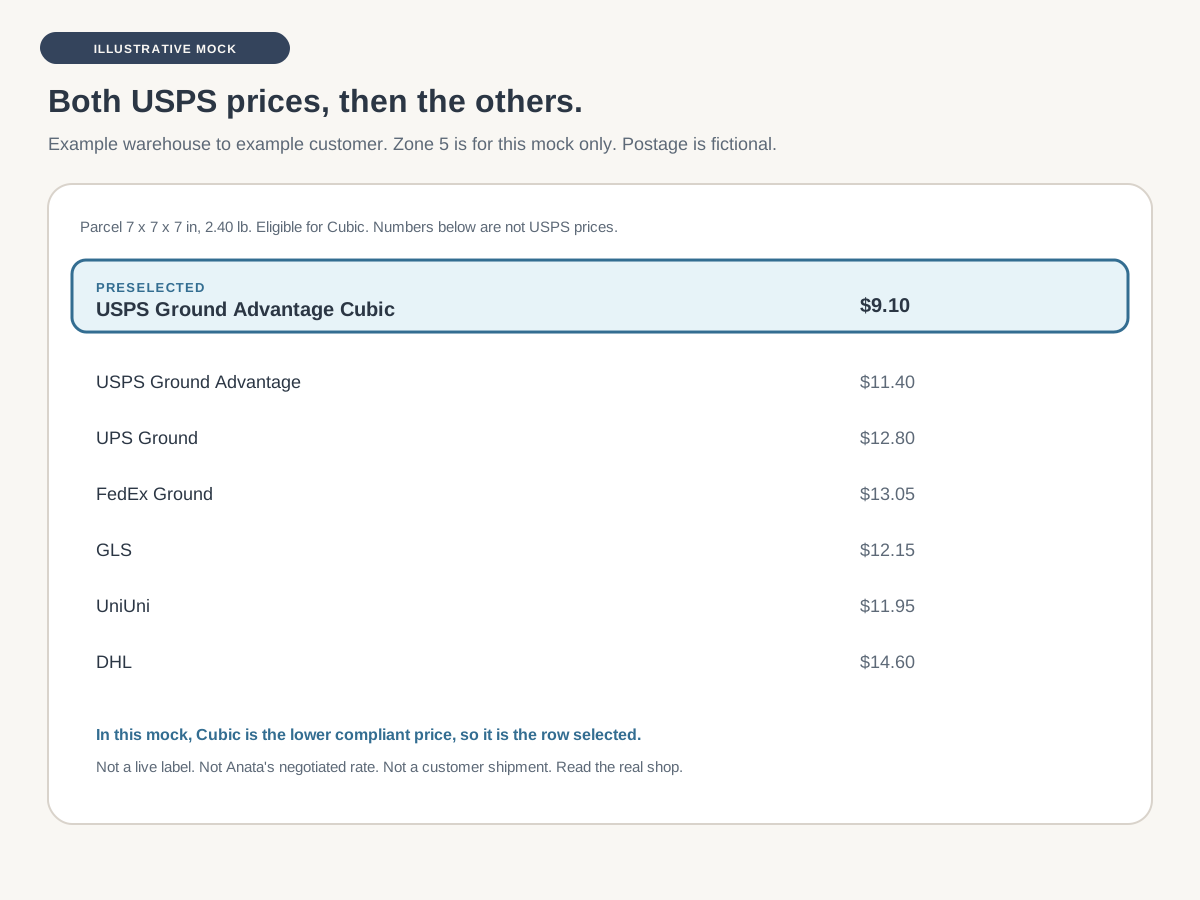
Shipping OS is built to show both USPS prices in the same shop as the other services on Anata's negotiated accounts: UPS, FedEx, GLS, UniUni, and DHL. When the parcel is eligible for Cubic, both the regular Ground Advantage price and the Ground Advantage Cubic price belong in that shop, and the lower compliant service is the one the shop should preselect. That is the intended behavior. It is not a promise that every label, in every state of a rate table, has already been checked for you. Read the service name on the label before you buy it. The drawing uses a fictional origin, a fictional destination, and fictional postage so the shape of the shop is visible without anyone's shipment in it.
Re-check the rule when USPS changes the file. The commercial files behind the tables on this page are marked September 14, 2026. The Cubic eligibility text and the dimensional-weight rounding sentences in section 283 carry a July 12, 2026 revision marker. The peak window runs from October 4, 2026 through January 17, 2027. Those are three different dates. A rule saved before one of them can be a quiet overpayment after the next one, even when the crossover weight itself survived this particular peak add. Sample the boundary parcels after each change: a box just under 1 pound, a box at 16.02 ounces, a box on the tier edge, and a box that has crossed 1 cubic foot and is no longer Cubic at all.
If you would rather not run the warehouse, Anata fulfillment in Lehi does the physical work and ships on the same kind of rate shop. Call (385) 336-3562. If you are buying the label yourself, open Shipping OS or start from Buy a Shipping Label, rate the real parcel, and keep the measurements with the shipment record.
- Measure the sealed parcel, not the catalog size.
- Save dimensions, scale weight, zone, and both prices you compared.
- Confirm Cubic eligibility before you trust a Cubic row.
- Compare both USPS prices, then the other carriers in the shop.
- Preselect the lower compliant service, then read the service on the label.
- Re-check after the next USPS price file, not only during peak.
Questions, answered.
- Are Ground Advantage and Ground Advantage Cubic different speeds?
- No. They are two prices for USPS Ground Advantage. The product page describes a 2 to 5 business day service standard and included tracking. The Domestic Mail Manual says USPS does not guarantee delivery within a specified time. The price you buy does not select a different network.
- Does a 7 by 7 by 7 box get dimensional weight?
- No. The box is under 1 cubic foot. USPS applies dimensional weight to Ground Advantage only when the parcel exceeds 1 cubic foot. This box is either the weight price or the 0.20 Cubic price.
- Why can 16.02 ounces cost the 2 pound price?
- USPS treats any fraction of a pound as the next whole pound. 16.00 ounces is 1 pound. 16.02 ounces is over 1 pound, so the price increment is 2 pounds. On a 0.20 tier box, that step is where Cubic becomes the lower published commercial price.
- What does C5 mean on a Shipping OS export?
- The 5 is USPS zone 5, from the origin ZIP Code to the destination ZIP Code. The C is a rate-category letter in the shipping software, not a USPS zone and not a measure of distance. A higher price next to C than next to A, with the same zone number, is not evidence of a longer trip.


Sources.
- USPS DMM 283: Ground Advantage Commercial prices and eligibility
- USPS Notice 123: Price List
- USPS Ground Advantage commercial prices, September 14, 2026
- USPS Ground Advantage Cubic commercial prices, September 14, 2026
- USPS Ground Advantage
- USPS newsroom, August 25, 2026: temporary holiday price change
- USPS Employee News, October 4, 2026: temporary prices take effect
- USPS PostalPro: Zone Charts
- USPS Domestic Zone Chart
Rate-shop the real parcel, on Anata's negotiated accounts, in Shipping OS →