

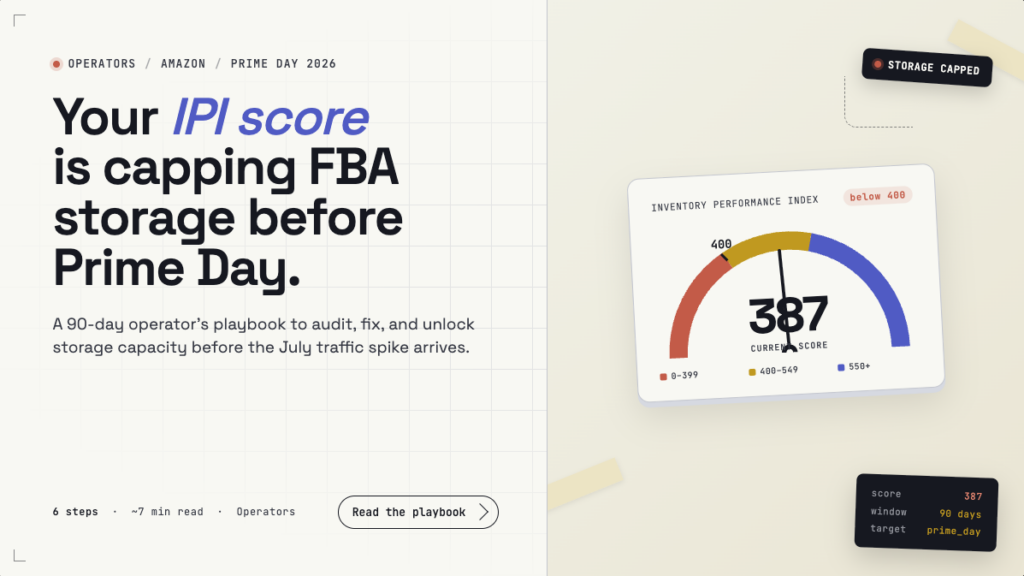
It is April. Prime Day is roughly 90 days out. If your Inventory Performance Index (IPI) score is sitting below 400, Amazon has already put a hard ceiling on how much inventory you can send to FBA. Most brands do not notice this until June, when they try to build their Prime Day position and hit a wall. By then the lead time math does not work. Your inventory arrives late, your rankings do not have time to recover, and you watch better-prepared competitors capture the traffic you planned for.
The IPI score is not a vanity metric that Amazon shows you in a dashboard. It is an operational constraint that directly controls your available FBA storage. Operators who treat it that way win Prime Day. Operators who ignore it until summer scramble.
This post is for sellers doing at least seven figures on Amazon who want to use the next 90 days to get their storage position right before Prime Day volumes hit.
What Happened
Amazon introduced the Inventory Performance Index in 2018 as a way to ration FBA warehouse space among sellers. The formula has evolved, but the core mechanics are consistent: Amazon scores you on four factors that signal how well you manage inventory.
The four components are excess inventory percentage (are you sitting on too much slow-moving stock), sell-through rate (how fast your inventory is turning relative to replenishment), stranded inventory percentage (how much of your FBA inventory is not actually buyable due to listing issues), and in-stock rate on replenishable ASINs (are you maintaining availability on your best sellers).
Amazon updates your score weekly. Sellers above 400 get the standard storage allocation for their account tier. Sellers below 400 face a reduced storage limit, which Amazon communicates in Seller Central but which most brands do not actively monitor until it becomes a problem. In 2026, with FBA fee increases in place across storage and fulfillment tiers, the cost of getting this wrong is higher than it has ever been.
The threshold that matters most operationally is 400. Below that number, Amazon restricts how much cubic footage you can hold across all of FBA. This is not a soft suggestion. It is enforced at the shipment creation level. You will be blocked from creating inbound shipments that exceed your storage limit.
Why This Matters for Operators
The math is straightforward. If Prime Day drives 4x to 8x your normal daily velocity on your best ASINs and you cannot get enough inventory into FBA beforehand because your storage limit is capped, you are leaving real money behind.
Here is how the constraint compounds. If your IPI is below 400 today, your storage limit is already reduced. To build a Prime Day inventory position, you need to ship products to FBA somewhere between 8 and 12 weeks before the event to allow for inbound processing time and to give your listings enough sales history to rank competitively during the event. That window is open right now. If you miss it, you are not making up the difference in June.
The margin impact is not just the lost Prime Day revenue. Brands carrying excess inventory on slow-moving SKUs to protect overall in-stock are often paying FBA monthly storage fees at the higher Q3 rate (July, August, September carry premium storage pricing) on inventory that is suppressing their IPI score in the first place. The excess on the slow SKUs is eating storage budget that should go to the fast movers.
The in-stock rate component also matters here. If you are stocking out on your best ASINs because you over-allocated storage to slower products, your IPI takes a hit on two dimensions at once: your in-stock rate drops and your sell-through rate for the account deteriorates because the fast movers are not moving.
What Most Brands Get Wrong
The most common mistake is treating IPI as a reporting metric rather than a planning input. Brands check it quarterly, or after it drops, rather than building weekly IPI monitoring into their operations cadence. By the time a score drop shows up in a QBR, the storage limit has already been in place for weeks.
The second mistake is a failure to connect SKU-level inventory decisions to the IPI components. Excess inventory on even a handful of slow SKUs can drag down the excess inventory percentage enough to push a score below the 400 threshold. Many operators let these SKUs sit because the unit economics on a removal order or liquidation look bad in isolation. The correct frame is the cost of reduced FBA storage capacity on your entire catalog, not the margin on the removal itself.
Stranded inventory is the most overlooked component. Listings go stranded for reasons that feel minor: a pricing alert, a suppressed listing, a compliance flag, a category restriction. Brands that do not have a weekly stranded inventory workflow let these accumulate. Each stranded unit is counted against your IPI but generates no revenue. It is pure drag.
The fourth mistake is trying to fix IPI in June for a July Prime Day. The score update is weekly, but storage limit changes based on score movement take time to flow through. And even if your limit increases, you need the lead time to source, ship, receive, and season the inventory. June is too late for meaningful correction.
What You Should Do Next
These steps are ordered by impact. Start at the top.
1. Audit your current IPI score and storage limit. Go to Seller Central, then Inventory, then Inventory Performance. Check your current score, your storage limit by category, and the breakdown of which components are dragging your score. The dashboard shows you exactly where the problem is.
2. Clear stranded inventory this week. Run a stranded inventory report and work through every ASIN. Relist what can be relisted. Remove or destroy what cannot. Every stranded unit you clear is an immediate IPI improvement and a reduction in storage fees.
3. Create removal orders on excess slow-movers. Pull a 90-day sales velocity report. Any ASIN with more than 90 days of supply at current velocity is hurting your excess inventory percentage. Calculate the removal cost against the storage fees you are paying, and against the storage capacity you are consuming that could go to faster-moving SKUs.
4. Build your Prime Day position through a 3PL buffer. Rather than sending your full Prime Day inventory to FBA in one inbound, use a 3PL to stage inventory and make smaller, more frequent FBA shipments. This approach keeps your sell-through rate healthy because you are not flooding FBA with 120 days of supply at once. It also gives you flexibility to redirect inventory if a listing underperforms. Anata’s fulfillment services are built for exactly this kind of FBA/3PL hybrid workflow.
5. Increase replenishment frequency on your top ASINs. Smaller, more frequent inbounds on your best sellers improve your sell-through rate and in-stock rate simultaneously. This is a faster IPI lever than clearing excess, and it is where most operators have the most room for improvement.
6. Set a weekly IPI review cadence through June. This does not need to be a long meeting. It is a 15-minute check: current score, storage limit by category, which ASINs moved into excess this week, and what shipments are scheduled. Build it into your weekly operations rhythm now so it is automatic by the time Prime Day prep accelerates.
If you want a structural breakdown of how to set up your Amazon operations for consistent IPI management alongside your broader margin stack, Anata’s Amazon management services include this as part of ongoing account oversight.
Working with Anata on This
If IPI monitoring and FBA storage planning are consuming time your team does not have, this is something Anata handles as a standard part of Amazon operations management. We track IPI weekly, flag stranded inventory before it compounds, and coordinate your FBA and 3PL fulfillment mix so your Prime Day inventory position is built deliberately rather than reactively. If you are running a multi-SKU catalog on Amazon and have a Q3 revenue target, it is worth a conversation. Learn more about our full suite of shipping and logistics services or visit Anata’s services overview to see the full scope.
FAQ
What is a good Amazon IPI score?
Amazon sets 400 as the threshold for standard storage access. Scores above 400 qualify for the default storage limit for your account tier. Scores above 550 are considered strong and indicate healthy inventory turnover with minimal excess or stranded stock. Most actively managed accounts can maintain scores between 500 and 650 with consistent weekly attention.
What happens if my IPI score drops below 400?
Amazon reduces your FBA storage limit when your score falls below 400. The specific reduction varies by account and category, but it is enforced at the shipment creation level. You will be blocked from sending inbound shipments that would exceed your new, lower limit. This restriction can prevent you from building adequate inventory for seasonal peaks including Prime Day.
How do I raise my IPI score quickly?
The fastest levers are clearing stranded inventory and creating removal orders on excess stock. These two actions directly improve the excess inventory percentage and stranded inventory percentage components of your score. Increasing replenishment frequency on your best-selling ASINs to improve sell-through rate is the next fastest lever. Score updates happen weekly, so meaningful improvement is possible within two to four weeks of sustained action.
Can I use a 3PL to work around FBA storage limits?
A 3PL does not bypass FBA storage limits, but it changes the operational calculus significantly. By staging inventory at a 3PL and shipping to FBA in smaller, more frequent batches, you keep your FBA sell-through rate high (which improves IPI), maintain Prime-eligible inventory without overloading your storage allocation, and give yourself more flexibility in how you allocate limited FBA capacity across your catalog. It is the standard approach for operators managing high-SKU catalogs with seasonal peaks.
How far in advance should I send Prime Day inventory to FBA?
For a July Prime Day, operators typically start sending incremental inventory in May and accelerate in June. For ASINs where you need to build ranking momentum through pre-Prime Day sales, earlier is better. The practical constraint is your IPI score and storage limit, which is why the April window to clean up excess and stranded inventory is so important. Fixing your score now gives you the storage capacity to execute the inbound strategy in May and June.
Conclusion
Your IPI score is not something to revisit when Prime Day prep ramps up. It is something to manage now, because the storage capacity you unlock over the next 30 days determines how much inventory you can actually position before the traffic spike arrives.
Clear your stranded inventory. Remove excess on slow SKUs. Build your Prime Day position through a 3PL buffer and more frequent inbounds. Set a weekly review cadence and hold it through June.
The operators who win Prime Day 2026 are the ones who treated April as the starting line.
If you want to talk through how Anata can manage this as part of your Q2 operations, start here.