

Shipping Software Comparison for SMBs: Choose the Right Stack to Cut Surcharges and Improve Shipping Efficiency
If your shipping bill keeps climbing in 2026, it is not only because of base rate increases. More of the pain comes from how carriers assess packages and apply accessorial fees. FedEx and UPS added cubic volume triggers that can make “not that big” boxes qualify for dimensional additional handling or oversize style charges, including thresholds like 10,368 cubic inches and 17,280 cubic inches, plus 110 lb criteria in some cases (Supply Chain Dive).
That is why a shipping software comparison is no longer a “nice to have” project. For many SMBs, the right stack pays for itself by reducing avoidable fees, improving label accuracy, and making it easy to route orders to the best carrier or 3PL on every shipment.
This guide breaks down what to look for, how to evaluate tools, and how to match software to your order profile. If you sell on Amazon, Shopify, TikTok Shop, or marketplaces, these principles still apply because your cost drivers are packaging, service selection, and fulfillment execution.
Why shipping software matters more in 2026
Carriers are using more measurement based rules
When carriers expand how they assess packages, your costs can spike even if your order volume stays flat. For example, the introduction of cubic volume thresholds means that a box can trigger dimensional surcharges based on its overall volume, not only weight or a single long side (Supply Chain Dive).
DIM weight is still a core driver you can control
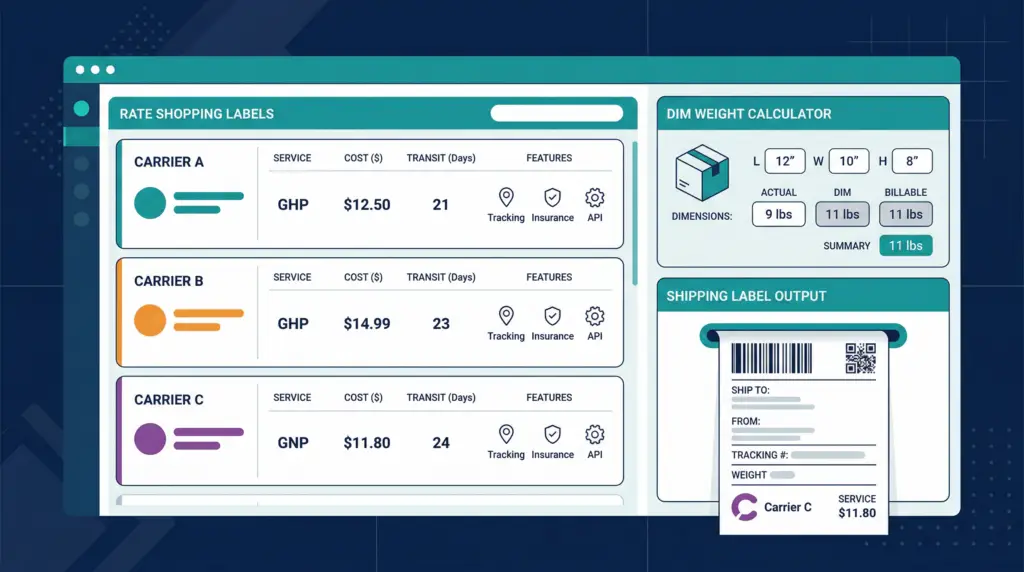
Dimensional weight pricing charges based on the space a package takes up. The core formula is straightforward: measure length, width, and height, multiply to get cubic inches, then divide by the carrier’s DIM divisor, and the carrier bills the greater of actual weight or DIM weight (ShipBob).
Software cannot change carrier rules. But it can help you execute the controllable parts: right sizing boxes, enforcing packaging SOPs, warning on risky dimensions, selecting smarter services, and routing to the right fulfillment node.
Shipping software comparison: the 10 capabilities that actually move cost
Many tools promise “save on shipping” without explaining how. Use the checklist below to compare platforms in a way that connects directly to fees and operational throughput.
1) Rate shopping across carriers and services
At minimum, your tool should compare rates across USPS, UPS, and FedEx services for each order. The best platforms also support regional carriers and let you create rules like “ship the cheapest service that delivers in 3 days or less.”
2) Rules based routing and service automation
Rules reduce human variance. Look for automation that can route based on destination zone, order value, SKU characteristics, and shipping method selected at checkout. This is often where shipping efficiency SMB teams see the biggest throughput gains.
3) Address validation and deliverability checks
Bad addresses create rework, reshipments, and avoidable fees. Your platform should validate addresses and flag PO boxes, non deliverable locations, and common formatting errors before labels print.
4) Box logic, cartonization, and DIM risk flags
If your current workflow depends on a packer “eyeballing” the best box, you are likely paying too much DIM weight. Good tools support box libraries and recommend box sizes based on SKU dimensions. Even better, they warn when a packed box crosses a known risk threshold, so you can repack before it becomes an expensive shipment.
5) Pick and pack workflow support
Some shipping tools only handle labels. Others support scan based picking, batch waves, and pack verification. If you are doing in house fulfillment, this is essential to avoid wrong item shipments and to keep line speed consistent.
6) WMS and 3PL integrations
If you use a 3PL, your shipping software comparison should include how smoothly the tool connects to your warehouse. The integration should pass accurate order data, line items, and shipping method rules. Otherwise you will have “split brain” decision making where checkout says one thing and the warehouse does another.
If you are evaluating a partner for 3PL pick and pack services, the software stack is part of the value. A good 3PL can provide strong shipping logic, negotiated rates, and consistent SOP execution.
7) Insurance, declared value, and exception workflows
For higher value items, you need workflow support around insurance and claims. The tool should make it easy to set coverage rules, print documentation, and track exceptions like damaged packages or delivery claims.
8) Returns and label reuse
Returns are part of shipping cost. Look for tools that simplify returns labels, provide scan based drop off options, and allow you to analyze return reasons and rates. This reduces customer support load and gives you a lever to reduce avoidable returns.
9) Cost analytics and surcharge visibility
You cannot fix what you cannot see. Your platform should break down spend by service, zone, package type, and surcharge category. The goal is to spot patterns like “this SKU triggers additional handling constantly” or “multi box orders are getting hit with per package residential fees.”
10) Multi channel order management
If you sell on Shopify, Amazon, and other channels, you want a single source of truth for orders and shipping status. The tool should sync orders, track numbers, and status updates without manual exports.
How to choose the right shipping software for your business model
If you ship 20 to 200 orders per day from one location
- Prioritize label speed, automation rules, and address validation.
- Choose a tool with a clean packing flow and easy user permissions.
- Ensure reporting is clear enough to spot fee drivers quickly.
If you ship multi box orders, bulky items, or awkward cartons
- Prioritize cartonization, box libraries, and DIM and cubic volume alerts.
- Look for strong measurement workflows to reduce “surprise” dimensional fees.
- Build packaging SOPs that your software can enforce at the packing station.
If you use a 3PL warehouse
- Prioritize 3PL integration quality and data accuracy.
- Ask how the 3PL manages packaging standards and carrier service rules.
- Confirm how billing data is shared so you can audit shipping costs.
Shipping efficiency SMB playbook: a practical evaluation process
Step 1: Build a shipping profile from real order data
Pull the last 60 to 90 days of shipments and group them by service, zone, and package size. Identify what portion of orders are lightweight but large. Those are your DIM risk orders, and they often benefit the most from better packaging logic.
Step 2: Score tools with a weighted rubric
Create a simple scoring model using the 10 capabilities above. Weight the top three based on what drives your costs. If surcharges are the biggest issue, weight analytics and DIM control highest. If labor is the pain, weight pick and pack workflow support highest.
Step 3: Run a pilot on a controlled set of orders
Do not switch everything at once. Pilot one station or one product line. Compare label time, error rates, and shipping cost per order. Track exceptions carefully so you know what changed.
Step 4: Document SOPs and lock them in
The fastest savings come when you remove guesswork. Document how to select packaging, when to split orders into multiple cartons, and when to upgrade service. Then configure your software rules to reinforce those SOPs.
Where a 3PL can outperform software alone
Software is powerful, but it still depends on consistent execution. If your team is stretched thin, a 3PL can provide a higher level of process control. The best fit is when your order volume is growing and you need speed, accuracy, and cost control without adding headcount.
If you are looking for 3PL fulfillment Utah options, focus on partners who can show measurable improvements in packing consistency, shipping cost visibility, and delivery performance. A local 3PL can also reduce transit times for western states and improve customer experience.
CTA: get a shipping and marketing efficiency review
If you want help selecting the right stack, Anata can review your current shipping workflow, carrier mix, and fulfillment setup. You will get practical recommendations you can implement quickly.
Request your free marketing analysis or contact us to talk through your shipping software comparison and fulfillment options.