

Amazon Customer Analytics in 2026: Turn Brand Store Insights into Repeat Buyers
If you are running Amazon ads and improving your listings, you already know the hard part is not traffic. The hard part is learning why shoppers choose you, what made them hesitate, and what will bring them back.
That is where amazon customer analytics becomes a growth lever. In 2026, brands have more signals than ever, including new section level engagement insights inside Amazon Brand Stores and more ways to connect first party data to Amazon signals for smarter measurement.
This guide breaks down how to use Amazon data to build amazon brand loyalty, not just short term conversions. You will leave with a practical framework, a weekly dashboard plan, and a set of tests you can run inside your store, listings, and ad account.
What “amazon customer analytics” actually means
Amazon customer analytics is the practice of combining the shopper signals Amazon gives you with your own business goals so you can answer three questions:
- Discovery: How are shoppers finding us and what are they responding to?
- Decision: What content, offers, and trust elements move them from interest to purchase?
- Retention: What makes them return, buy again, or buy additional items?
Most teams stop at “ads performance.” Customer analytics goes further. It connects what happens before the click and after the purchase to the content and merchandising decisions you control.
Start with a loyalty friendly view of the funnel
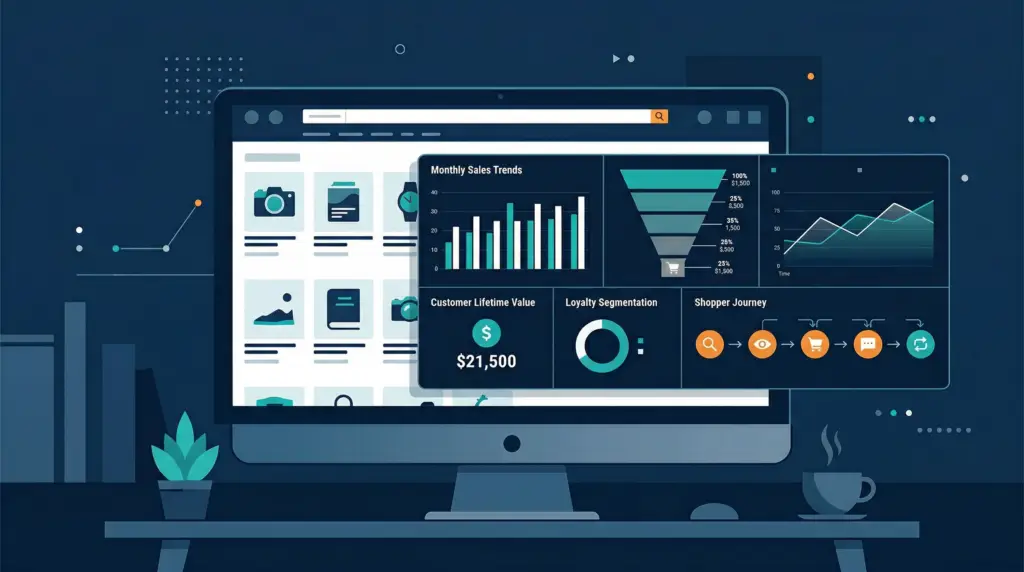
To build repeat buyers on Amazon, you need a funnel model that matches how shoppers behave. A useful, simple version looks like this:
Stage 1: Entry points
Common entry points include Sponsored Products, Sponsored Brands, organic search, and your Brand Store. The goal here is not only reach. It is qualified reach.
Stage 2: Proof and clarity
After a shopper lands on your listing or store, they are asking: “Is this for me, is it credible, and does it solve my problem?” Your main image, title, bullets, A plus content, and store modules all contribute.
Stage 3: First purchase confidence
Pricing, reviews, shipping promise, variations, and simple offers matter. The fastest way to lose a customer is to win the click but fail on confidence.
Stage 4: Second purchase pathway
Repeat buying on Amazon often comes from the right product mix, clear product relationships, and an experience that makes reordering easy. This is where amazon brand store optimization pays off because the store can guide shoppers to complementary products and reduce the “back to search” effect.
Use Brand Store section insights to find your strongest loyalty builders
Amazon announced section level shopper engagement insights for Brand Stores in January 2026, including metrics like renders, viewable impressions, clicks, and click through rate for each store section.[Amazon Ads](https://advertising.amazon.com/resources/whats-new/brand-store-insights-at-section-level-beta)
That matters because it lets you treat your Brand Store like a measurable landing page. Instead of guessing which module is “nice to have,” you can tie section performance to your merchandising plan.
What to look for in section level metrics
- High renders, low clicks: shoppers see it but do not act. Often a messaging, image, or offer clarity issue.
- High viewable impressions, low CTR: the section is visible but not compelling. Test a sharper headline and a clearer value proposition.
- High clicks but weak downstream results: the section attracts attention but sends shoppers to a poor product page. Improve the destination listing first.
A simple weekly Brand Store check
Each week, pick your top 5 store sections by renders and clicks. Then answer:
- Which sections pull shoppers deeper into the brand?
- Which sections act like exits?
- Which products are clicked most from the store, and do those products lead to additional cart adds?
This is a practical way to move from “we updated the store” to “we can prove the store is improving customer journeys.”
Build an Amazon analytics dashboard that connects to real decisions
Many teams have reporting but no cadence. The best amazon analytics dashboard is one that triggers a decision every week.
Core weekly dashboard metrics
- Brand Store: section renders, viewable impressions, clicks, CTR, and top clicked products
- Detail page quality: conversion rate, unit session percentage, review rating trends, and returns signals
- New to brand and retention proxy: new customer share where available, plus repeat purchase indicators by hero ASIN
- Offer health: buy box or featured offer coverage, pricing consistency, and delivery promise by ASIN
You do not need perfect attribution to make progress. You need consistent measurement and a testing loop.
Turn metrics into actions with a “why ladder”
When you see a change in performance, run this ladder:
- Where is the drop or lift? store section, ad placement, listing, or offer
- What is the likely cause? creative, keyword intent, pricing, reviews, delivery promise
- What is the smallest test? one store section rewrite, one image swap, one PDP content update
- What is the success metric? CTR, conversion, add to cart, or repeat purchase proxy
Use Amazon Marketing Cloud style thinking to connect journeys
At CES 2026, Amazon Ads highlighted how Amazon Marketing Cloud and AWS Clean Rooms can help brands connect their data with authenticated signals in a privacy forward environment.[Amazon Ads](https://advertising.amazon.com/library/news/ces-2026-advertising-news)
You do not need an enterprise team to adopt the mindset. The key is to stop looking at campaigns in isolation and start asking journey questions.
Three journey questions that improve amazon brand loyalty
- What paths lead to the highest conversion? Example: Sponsored Brands to Brand Store to hero ASIN
- What content assists conversion? Example: store education section drives clicks that later convert through Sponsored Products
- What audiences behave differently? Example: first time shoppers vs repeat customers, and how they respond to bundles or subscription options
Even if you are not running advanced clean room measurement, mapping these questions forces better creative briefs and better store design.
Five tests that turn customer insights into repeat purchases
Once you have a basic analytics cadence, run small experiments. Here are five tests that tend to improve both conversion and loyalty signals.
Test 1: Rewrite one Brand Store section headline for intent
Pick a high render, low click section. Rewrite the headline to match a shopper problem, not a brand claim. Keep it specific and outcome focused.
Test 2: Build a “start here” path for first time shoppers
Create a section that explains which product to buy first and why. First purchases are often lost to confusion. Reduce choice overload.
Test 3: Create a complementary product section to increase second purchase likelihood
Use your store to connect your hero ASIN to accessories, refills, or add ons. This is a direct way to improve repeat behavior because you are teaching shoppers what comes next.
Test 4: Align ad creative with the highest performing store sections
If a store section is earning high engagement, borrow its message and visuals for Sponsored Brands creative. Consistent messaging across touchpoints builds trust.
Test 5: Fix the listing that your store sends the most traffic to
Look at your top clicked product from the store. If that product page is weak, you are leaking customers. Improve images, tighten bullets, and make the offer simple.
Common mistakes that block amazon customer analytics
- Measuring everything: too many charts and no decisions. Start with a weekly scorecard.
- Overreacting to short windows: give tests enough time to normalize, especially for lower volume ASINs.
- Ignoring operations: delivery promises, inventory, and returns can erase marketing wins.
- Not updating the Brand Store: the store is not a one time project. Treat it like a landing page that you improve monthly.
How Anata Inc. helps brands turn amazon analytics into growth
Anata Inc. helps growing ecommerce teams connect the dots between content, advertising, and fulfillment so the customer experience stays strong from first click to repeat order. If you want a clearer view of what is working and what to fix next, request a free analysis.
Get started here: https://anatainc.com/free-marketing-analysis/ or reach out via https://anatainc.com/contact/.