

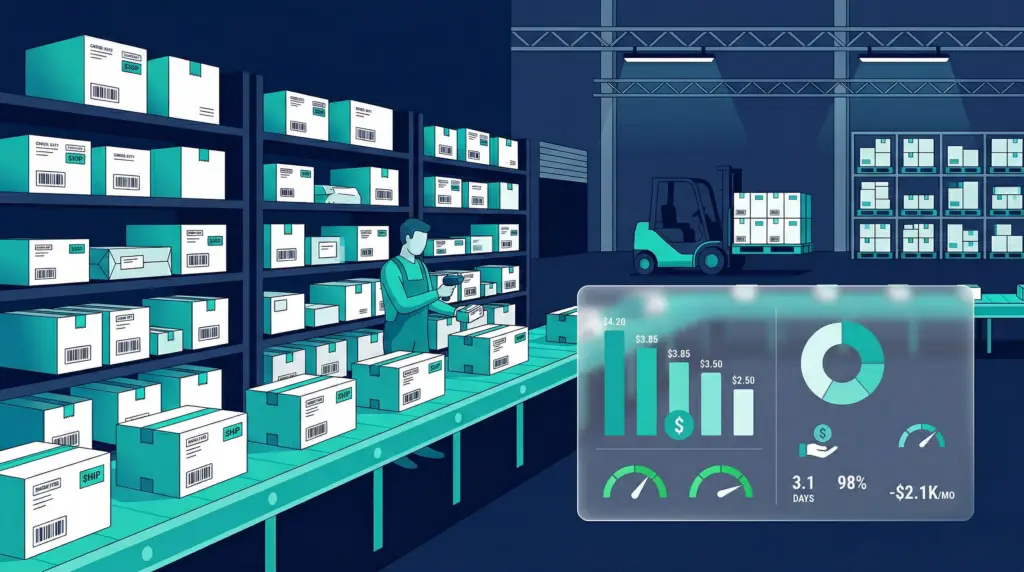
Shipping in 2026 is not just about getting a box from point A to point B. For small and midsize businesses, the big cost swings often come from accessorial fees, dimensional rules, and last mile surcharges that stack up quickly. The good news is that you can improve shipping efficiency without shipping more volume or locking into a risky carrier bet. You can win by tightening your packaging, cleaning up your address data, and building a smarter fulfillment workflow that keeps you out of the penalty box.
This guide is a practical, operator friendly plan. It covers what changed across the major carriers, what those changes mean for your daily shipping decisions, and how to use smart fulfillment and 3PL pick and pack to keep service fast while controlling spend.
What changed in 2026 that hits shipping efficiency for SMBs
Most SMBs feel cost increases first in the form of surcharges, not published base rates. When residential delivery charges and handling fees rise, it raises the true cost per order and reduces your margin headroom for promotions, free shipping thresholds, and fast delivery promises.
UPS: higher rates plus rising residential and delivery area surcharges
UPS announced an average 5.9% general rate increase, with changes effective December 22, 2025, and emphasized that impact varies based on shipping profiles and contract terms (Supply Chain Dive). That same update highlighted higher surcharges that show up on a large share of DTC shipments, including residential and delivery area fees (Supply Chain Dive).
For example, UPS residential surcharge for Ground increased from $6.10 to $6.50, and residential surcharge for Air increased from $6.55 to $7.00, effective December 22 (Supply Chain Dive). Those fees can apply to a huge share of ecommerce orders, so even if your base rate discount is strong, your blended shipping cost can still climb.
FedEx: residential fees and address correction penalties that SMBs must manage
FedEx residential delivery surcharges for 2026 include $6.45 for FedEx Ground and FedEx Home Delivery and $6.95 for FedEx Express, with an effective date of January 2026 (Reveel Group). If you ship primarily to homes, this is a repeatable per order cost driver rather than an edge case (Reveel Group).
Another silent margin killer is address correction. Reveel notes FedEx charges $24 per address correction effective January 2026 (Reveel Group). For SMBs, that is a direct penalty for bad data that can be prevented with basic checkout and label validation.
USPS: cubic pricing eligibility expands, creating a real opportunity
If you ship lightweight orders, USPS can still be a lever. Ordoro reports that the maximum eligible length for cubic pricing increases from 18 inches to 22 inches for Ground Advantage and Priority Mail, and states USPS changes begin in July 2026 (Ordoro). That change can make certain longer, still machinable boxes cheaper than before, if your packaging strategy is set up to take advantage of cubic tiers (Ordoro).
The 2026 shipping efficiency SMB scorecard: where costs really come from
To improve shipping efficiency, do not start with carrier switching. Start by auditing the parts of your process that create avoidable fees. In practice, your cost per shipment is driven by five buckets:
- Package geometry: box size choices, void fill, and how often you ship air.
- Address quality: typos, missing unit numbers, and bad ZIP plus 4 data.
- Service selection: when you default to fast services that the buyer did not value.
- Pick and pack execution: accuracy, packout speed, and packaging consistency.
- Network decisions: where you store inventory and how far you ship to reach buyers.
These buckets are controllable. The goal is to reduce penalty exposure so your carrier discounts actually matter.
Smart fulfillment tactics that reduce surcharges without slowing delivery
1) Fix packaging first: reduce dimensional exposure and unlock cubic pricing
Packaging is the fastest lever because it changes what carriers measure. Most SMBs have a packaging catalog that grew organically over time, with too many similar boxes and no clear rules on when to use each one. In 2026, that inconsistency becomes expensive.
- Create a box decision tree based on product size bands, not SKU by SKU guesswork.
- Design for repeatability so packers do not improvise box choices under time pressure.
- Measure the top 20 SKUs and set a target packout: minimal void, minimal dunnage, consistent orientation.
- Re test USPS cubic eligibility for lightweight, longer boxes. With cubic length eligibility reported to expand to 22 inches in July 2026, some orders that previously missed cubic tiers may now qualify (Ordoro).
A practical way to start is a two week packaging sprint. Pick one product line with steady volume. Standardize box sizes, train packers, and compare average billed weight, damage rate, and shipping cost per order before and after. When you can prove savings on one lane, scaling is easy.
2) Make address quality a KPI, not a customer support problem
Address correction fees are not random. They usually come from a small set of root causes: missing apartment numbers, copy paste errors on mobile, and customers entering shipping addresses that do not match carrier databases. If you are seeing a steady trickle of corrections, you are likely losing money every week.
Since FedEx address correction can be $24 per package in 2026, the payback period on validation is often immediate (Reveel Group).
- Add address autocomplete and validate against USPS style formatting at checkout.
- Require unit fields when the street indicates an apartment complex.
- Flag high risk addresses for manual review before you print a label.
- Track correction rate by channel so you can find the source. Marketplaces, wholesale portals, and phone orders often behave differently.
3) Use shipping rules so service selection matches the promise you actually made
Many SMBs overspend by defaulting to the same service for every order. The buyer might not care about two day shipping on a replenishment item, but you pay for it anyway. You can reduce cost and still protect the customer experience by using rules that map order attributes to service levels.
Examples of service rules that work:
- Use economical ground services for low AOV orders unless the customer paid for expedited shipping.
- Route PO boxes and lightweight parcels to USPS options when transit time is acceptable.
- Use expedited services only for high margin items, subscriptions at risk, or late orders.
When you implement rules, monitor delivery performance and refunds for late delivery. The goal is to reduce unnecessary upgrades, not to take on more customer support work.
4) Reduce residential exposure by positioning inventory closer to customers
Residential surcharges in the mid single digits per package may not sound dramatic, but at scale they add up quickly. UPS residential ground surcharge is shown at $6.50 effective December 22, and FedEx residential ground is shown at $6.45 effective January 2026 in the sources above (Supply Chain Dive; Reveel Group).
You cannot eliminate residential delivery, but you can shorten the distance. Shipping one zone closer often reduces base rate and sometimes reduces how frequently you trip handling thresholds. This is where a 3PL warehouse strategy becomes a competitive advantage.
3PL pick and pack: how to evaluate a partner for 2026 cost control
Outsourcing fulfillment is not just about labor. It is about process design. The best 3PL pick and pack setups reduce shipping cost by improving packaging consistency, reducing errors, and enabling multi location inventory.
What smart fulfillment should include
- Standardized packaging playbooks with documented packout instructions by product type.
- Quality checks that reduce re ships and customer complaints.
- Carrier rate shopping that compares services in real time using your rules.
- Fast receiving and accurate inventory so you do not oversell and rush ship later.
- Clear reporting for billed weight, surcharges, and address correction events.
Questions to ask a 3PL warehouse before you sign
- How do you decide which box to use for an order, and can you follow our packaging decision tree?
- Do you measure parcels at packout to reduce dimensional billing surprises?
- Can you flag bad addresses before labels are printed?
- What is your error rate, and how do you handle chargebacks from mis ships?
- Do you support multi node fulfillment, and how do you recommend allocating inventory?
If you are in the Mountain West, a 3PL fulfillment Utah footprint can be a practical way to reach both coasts efficiently while keeping inbound freight manageable. The key is not the ZIP code. The key is whether the operation has a repeatable packaging system, clean data practices, and shipping rules that reduce surcharge exposure.
Shipping software comparison: what features matter most for SMBs in 2026
Shipping tools are not all the same. In 2026, the best value often comes from tools that help you prevent penalties, not just print labels.
Look for these capabilities
- Automated rate shopping across carriers with delivery date estimates.
- Rules engine so you can map order attributes to services consistently.
- Address validation and exception handling before you pay for corrections.
- Box optimization recommendations and support for cubic pricing workflows.
- Surcharge reporting so you can see what is driving costs each month.
If you are doing a shipping software comparison, require a short pilot with your real order data. Track cost per order, correction rates, and exception time. A tool that saves ten seconds per order can be worth less than a tool that prevents a few $24 correction fees per week.
A simple 30 day action plan to improve shipping efficiency SMB teams can run
Days 1 to 7: baseline and quick wins
- Export last 60 days of shipments and summarize the top fees by dollar impact.
- Identify the top 10 SKUs by unit volume and measure them accurately.
- Turn on address validation and require missing unit numbers.
Days 8 to 21: packaging system and shipping rules
- Reduce your active box catalog to a manageable set with clear selection rules.
- Create a packing checklist and train staff on consistent packout.
- Implement rules based on weight, value, destination type, and promised delivery speed.
Days 22 to 30: fulfillment optimization and 3PL evaluation
- Compare single location shipping vs two node fulfillment on your top zones.
- Run a cost simulation that includes residential and delivery area surcharges, not just base rate.
- If you are considering outsourcing, request a walkthrough focused on how the 3PL handles packaging and exceptions.
When to bring in help
If shipping is consuming your team, it is usually a sign that the system needs to be redesigned. Whether you need better shipping software, a smarter fulfillment layout, or a 3PL warehouse partner, the goal is the same: keep customers happy while protecting margin.
Want a second set of eyes on your shipping and fulfillment setup? Request a free marketing and operations analysis, and we will identify your highest impact savings opportunities and quick wins. Visit https://anatainc.com/free-marketing-analysis/ or contact us at https://anatainc.com/contact/.